You can find influencers near you by using location filters on influencer platforms, searching geotags and local hashtags on social media, attending community events, or collaborating with local businesses that already work with creators. Tools like HypeAuditor allow you to search influencers by city or region.
Finding local influencers helps brands build authentic community connections, drive foot traffic, and create content that feels relatable to nearby audiences. It’s especially useful for restaurants, events, local stores, and regional campaigns that rely on in-person visibility or local trust.
“Local influencers often know their audiences better than anyone. They understand what people talk about, what they care about, and how to make a message sound real. That kind of connection can’t always be built through paid ads.”

Anna Komok
Chief Marketing Officer at HypeAuditor
How to search for nearby creators
1. Use influencer discovery platforms
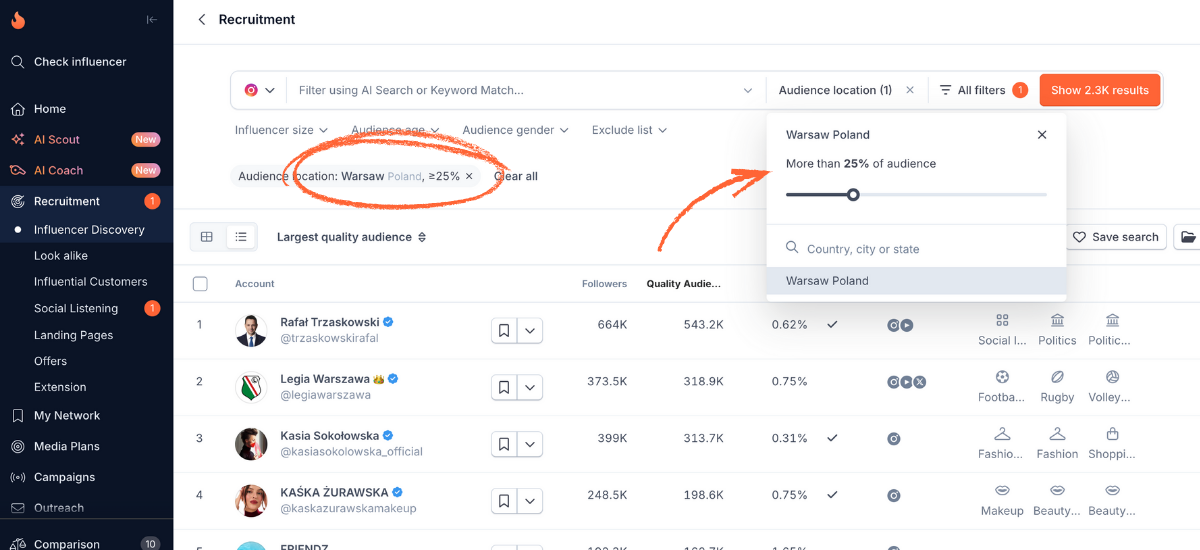
Influencer marketing platforms like HypeAuditor let you filter creators by location: country, state or even city. You can find creators who live in your area or whose followers are concentrated nearby.
2. Search local hashtags and keywords
On Instagram, TikTok, or YouTube, look for posts tagged with your city (e.g., #LondonFoodie, #NYCFashion, #MiamiEvents). This is an easy way to discover creators who actively post local content.
“Location-specific hashtags are the most obvious way to find local influencers. Or search through the followers/following of other influencers you’ve worked with in the past.” — from r/SocialMediaMarketing
 In addition to searching by hashtags, you can type the name of a location, and Instagram will automatically surface posts and Reels that mention it. I don’t recommend jumping straight to a specific hashtag, since you might misspell it. People often add emojis to hashtags, and there’s no way to predict which ones they’ll use. Plus, there are usually multiple variations of the same hashtag.
3. Search using geotags on Instagram
In addition to searching by keywords and hashtags, Instagram has a dedicated tab for location-based search. Simply type the name of a place and select the relevant geotag. A geotag can be anything - a city, a country, a state, or even a specific spot. Even a tiny two-table café can have its own geotag. This means you’ll likely spend quite a bit of time collecting different locations. But there are a few shortcuts that can help speed up the process.
 Type your location into the search bar. It’s usually better to start broad, with a neighborhood or city, rather than a specific spot. Go to the Places tab on Instagram and choose the geotag that fits your search. Once you click on it, you’ll land on a dedicated page for that location. There, you’ll see top posts by views as well as a recent tab with posts published most recently.
The profile photo on the location page is actually the location’s active Stories. If you tap it, you’ll see all Stories currently tagged with that geotag.
You can also switch to the map view using the bar at the top. By tapping "Search this area", Instagram will show you other nearby locations and content. This allows you to find creators who are posting content very close to you, sometimes down to a specific building or venue.
4. Check local event collaborations
If something notable is happening in your area, a festival, an opening, a pop-up, or any local event, chances are influencers will be there posting content. Check who the event organizers are tagging, and who is tagging the event’s account in return. This alone can surface many active local creators.
Location search on Instagram will also come in handy here. Events usually generate a spike in geotagged posts and Stories from the venue. You’ll have roughly 24 hours to catch all Stories posted from that location, so make sure to check the geotag’s active Stories soon after the event starts.
5. Partner with local businesses
Restaurants, gyms, salons, and cafes often collaborate with local creators. You can browse their tagged posts to see which influencers they’re already partnering with, or even reach out and ask for introductions.
There’s also a more structured way to uncover these collaborations: run Competitor Research in HypeAuditor. It will show you which creators have posted about local businesses in your area, who they’ve worked with, and what kind of sponsored content those creators publish. This helps you quickly map out the local influencer landscape and identify partners who are already active in your niche or neighborhood.
6. Leverage Google Search
Simple Google queries like “influencers in [city]” or “[city] creators” can surface lists, articles, local rankings, and media features. Many creators also appear in local news, event roundups, or “best of” guides, which makes Google an easy starting point for discovering active influencers in your area.
7. Explore influencer TOPs and Rankings
Another efficient way to discover local influencers is to browse influencer rankings. In HypeAuditor, you’ll find comprehensive TOPs across social networks, industries, countries, and even combinations of all three. For example, you can explore “Instagram + Beauty + France” or “YouTube + Humor + Germany” and instantly access curated lists of creators who perform well in that segment.
 Basic rankings are available for free on the website, even without registration. If you’re a HypeAuditor paid user, you’ll also get access to more detailed rankings with advanced segmentation filters.
You can also explore Top Trending Accounts, a list of creators who are growing right now. You can choose the exact time period you want to analyze: see who is gaining traction in your location this month, this week, or even over the past year. It’s one of the quickest ways to spot rising local creators before everyone else does.
8. Analyze local competitors with HypeAuditor’s Competitor Analysis
You can see which influencers are already collaborating with nearby restaurants, shops, or other local businesses. HypeAuditor’s Competitor Analysis shows who mentions these brands, helping you discover active creators in your area and filter them by location for potential partnerships.
What to keep in mind
Local doesn’t always mean micro. Some city-based influencers have large audiences that extend beyond their area, while others focus tightly on neighborhood life. When choosing who to collaborate with, focus more on how much of their audience is actually local rather than their follower size alone.
Also, verify their authenticity and engagement. Even local creators can have numbers that don’t reflect real engagement or followers outside your target region. Tools like HypeAuditor help you see audience geography, age, and engagement quality before investing in a partnership.
Lastly, think about content fit and frequency. Local creators often work across multiple small businesses at once, so try to align on exclusivity or posting windows early. A quick briefing on your brand values or tone can also help keep your campaign messaging consistent while still feeling native to their style.