

Talking about influencer tools can feel overwhelming, especially if you’re new to influencer marketing. Doing everything manually takes time and doesn’t scale, but choosing the right tool isn’t always easier. There are many options, many features, and most of the time, it’s not very clear on where to start.
We know how confusing this stage can be. It’s hard to tell which tools you actually need, which features matter, and how all of this helps you find influencers who are genuinely worth working with.
In this guide, we’ll walk you through the main types of tools used for influencer discovery and analysis, explain what each one is good for, and highlight the features that make the biggest difference. The goal is to help you find genuine influencers and review their profiles in a way that’s more efficient, more reliable, and easier to manage.
What tools can help find genuine social media influencers?
Today, brands and agencies are surrounded by creators. Every platform is crowded with influencers of all sizes, across every niche. In that environment, it’s reasonable to question whether an influencer is genuine - one whose audience is real, whose growth and engagement follow natural patterns, and whose content and behavior stay consistent over time. Identifying that requires more than surface-level metrics. Different tools reveal different indicators, each with its own strengths and limitations.
Below is a breakdown of the main tool types that help assess genuineness, and how each one should be used.
Native platform tools
Native platform tools are often the first place brands encounter potential influencers, and they do play a role in assessing genuineness, especially at an early stage.
These tools are useful for spotting:
creators with a clear niche and point of view
consistent content quality over time
organic audience interaction
How to use them for genuineness checks
Native tools work best as an early filter. They help you rule out creators with inconsistent behavior or poor content fit, and identify candidates that are worth deeper analysis using audience and authenticity-focused tools.
Where they fall short
What native tools cannot reliably show is who the audience really is and how engagement behaves over time. Audience location, quality, and historical growth patterns are either hidden or very limited. As a result, it becomes difficult to confirm genuineness when reviewing many creators or when decisions require data-backed confidence.
Influencer discovery platforms
Influencer discovery platforms help when manual searching is no longer practical. They bring large numbers of creator profiles into one place and make it easier to search, filter, and compare influencers using consistent criteria. Usually, they also come with influencer reports that help you see important insights about a creator.
What to look for in an influencer discovery platform:
Coverage: platforms, regions, and creator types that matter for your campaigns
Filters: audience size, location, language, engagement, niche, and keywords
Search logic: how well keyword searches work compared to fixed tags or labels
Audience insights: visibility into audience location, demographics, and overall quality
Account history: access to follower growth and engagement trends over time
Data update frequency: how often creator profiles and metrics are updated
How to use them for genuineness checks
Discovery platforms are best when you treat them like a screening tool with consistent rules.
Start with “fit” filters, then add “trust” filters
This keeps the list focused on relevance first, while still allowing you to screen for quality before shortlisting.
Example order: location/language → niche keywords → follower range → engagement range → audience geo → audience quality.
Dive into the account history
Start by checking follower and engagement trends over time. Genuine creators usually grow in a steady way that matches how often they post and how their content performs. Patterns like sudden spikes followed by flat periods, repeated step-like jumps, or sharp drops without a clear content trigger should be flagged.
When you see these, don’t shortlist the creator yet. Review their recent content, comment activity, and audience data to confirm whether the pattern has a reasonable explanation.
Cross-check the audience geo against the campaign goal
Always compare the creator’s audience distribution with the actual campaign goal. If you need a UK-heavy audience, don’t accept “global” as good enough. Put a minimum threshold in your notes (even if it’s rough).
Compare creators side-by-side with the same lens
Pick 3–5 “must-check” fields and review them for every creator. For example:
Audience top countries (and % in target market)
Engagement trend (stable vs volatile)
Growth pattern (steady vs suspicious spikes)
Content consistency (niche clarity + posting rhythm)
Brand fit note (1 line)
Where they fall short
Some platforms rely heavily on averages, which can hide what’s really going on. A creator might have one strong month followed by several weak ones, but the overall numbers still look fine. Audience quality insights can also be limited, often pointing out only the most obvious issues without fully confirming whether an audience is genuinely real.
Data can also lag behind reality. For fast-changing accounts, after a viral moment, a follower cleanup, or a sudden shift in content, the metrics you see may not yet reflect the creator’s current state.
Authenticity and fraud-check tools
Authenticity and fraud-check tools are usually part of broader influencer marketing platforms, alongside discovery and analytics features. Their role is not to find creators, but to help confirm whether the signals you’ve already noticed are trustworthy.
They help assess whether audience behavior looks natural, whether engagement aligns with reach over time, and whether audience composition remains stable. If the previous tool helps you see that something looks off, this kind of tool helps you understand why it looks off.
How to use them for genuineness checks
Use these tools once a creator passes basic discovery filters. If something stands out in their growth or engagement history, review audience quality, engagement distribution, and audience changes together. The goal is to confirm whether the data supports a reasonable explanation before shortlisting.
Where they fall short
These tools are best for audience and engagement authenticity. They don’t fully replace a content/brand-fit review, which still needs a separate check of the creator’s themes, tone, and past content.
Brand safety + content fit tools
Brand safety and content fit tools also don’t help you discover influencers, but they help confirm whether a creator is genuinely suitable once they’re on your radar. A real audience and real engagement don’t matter much if the creator’s content history doesn’t align with your brand.
These tools help you review:
Topic history over time (what they consistently talk about)
Risky or sensitive content, depending on your brand’s tolerance
Consistency of messaging and tone across posts and formats
Social listening + mention tracking
Social listening and mention tracking tools are one of the most overlooked ways to find genuinely relevant influencers. Instead of starting with follower counts, they start with real conversations happening around your brand. Because of this, outreach becomes easier and more genuine since you’re not asking someone to pretend to care, but you’re building on something they already do.
These tools are useful for uncovering smaller creators with strong trust, creators who wouldn’t show up in typical “top influencer” searches, and voices that feel authentic because they weren’t recruited through cold outreach.
What to monitor using this kind of tool:
Brand mentions and tags (including unprompted ones)
Product or use-case conversations
Category keywords and problem-focused language
Which tools are best for discovering and analyzing influencers?
In general, there isn’t a single “best” tool for every team. What matters is whether a tool helps you find relevant creators, understand them quickly, and make decisions you can explain. Instead of focusing on tool names, it’s more useful to look at the capabilities that actually support good discovery and analysis.
Before deciding which tool is the best for your team, prioritize tools that have these:
Large database and many filters
A reliable discovery tool should give you access to a broad creator pool and let you narrow it down. Filters such as audience size, location, language, niche, and engagement rate are also important to make your search more specific and help you be more selective.
AI-powered search
AI-based search is useful when creators don’t describe themselves in neat categories. It helps surface profiles based on topics, content themes, or similar creators, even when keywords aren’t an exact match.
Audience insights and authenticity checks
Discovery is only useful if you can see who actually follows a creator. Tools should show where the audience is located, how it’s distributed, and whether it looks healthy. Built-in authenticity signals help you avoid relying on follower count alone.
Performance analytics
Good tools let you review how content performs over time. Post-level views, engagement patterns, and format performance help you understand what a creator can realistically deliver.
Account growth and engagement history
Historical data adds context. It shows whether growth and engagement are stable, improving, or unpredictable, which makes comparisons more grounded and less subjective.
If you’re not sure where to start, or you want one tool that covers most of these needs in a single place, HypeAuditor works well as an all-in-one example.
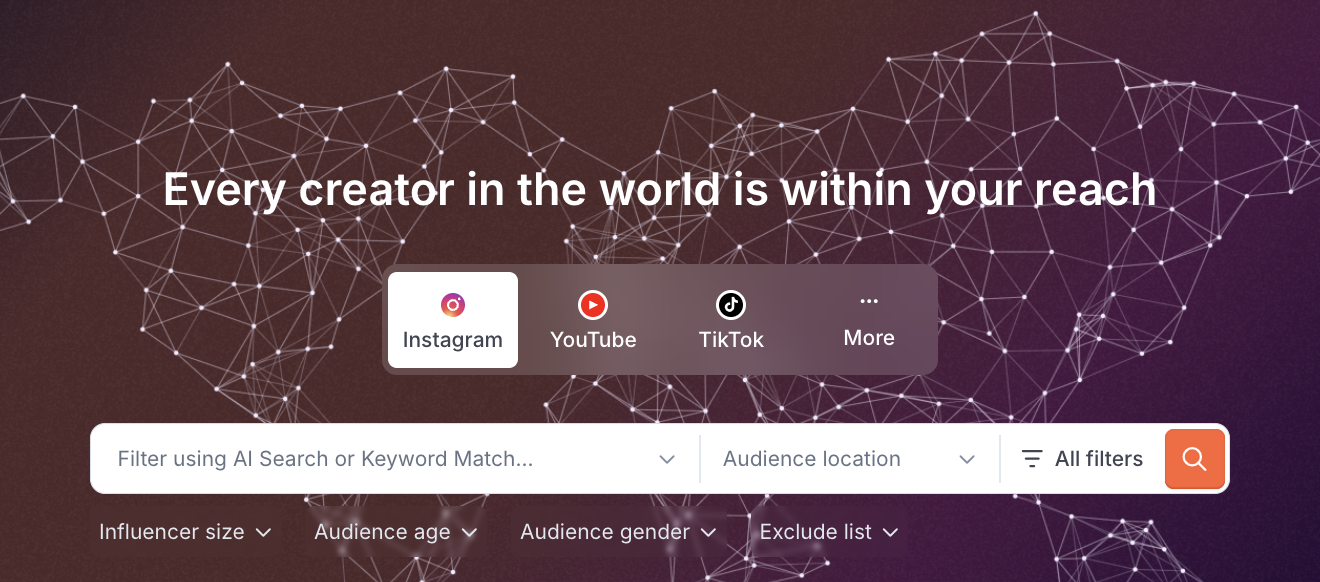 HypeAuditor is commonly used for influencer discovery and evaluation across major platforms, including Instagram, YouTube, TikTok, X (Twitter), and Twitch. It helps teams turn a wide search into a focused shortlist, without having to open dozens of tabs or review profiles one at a time.
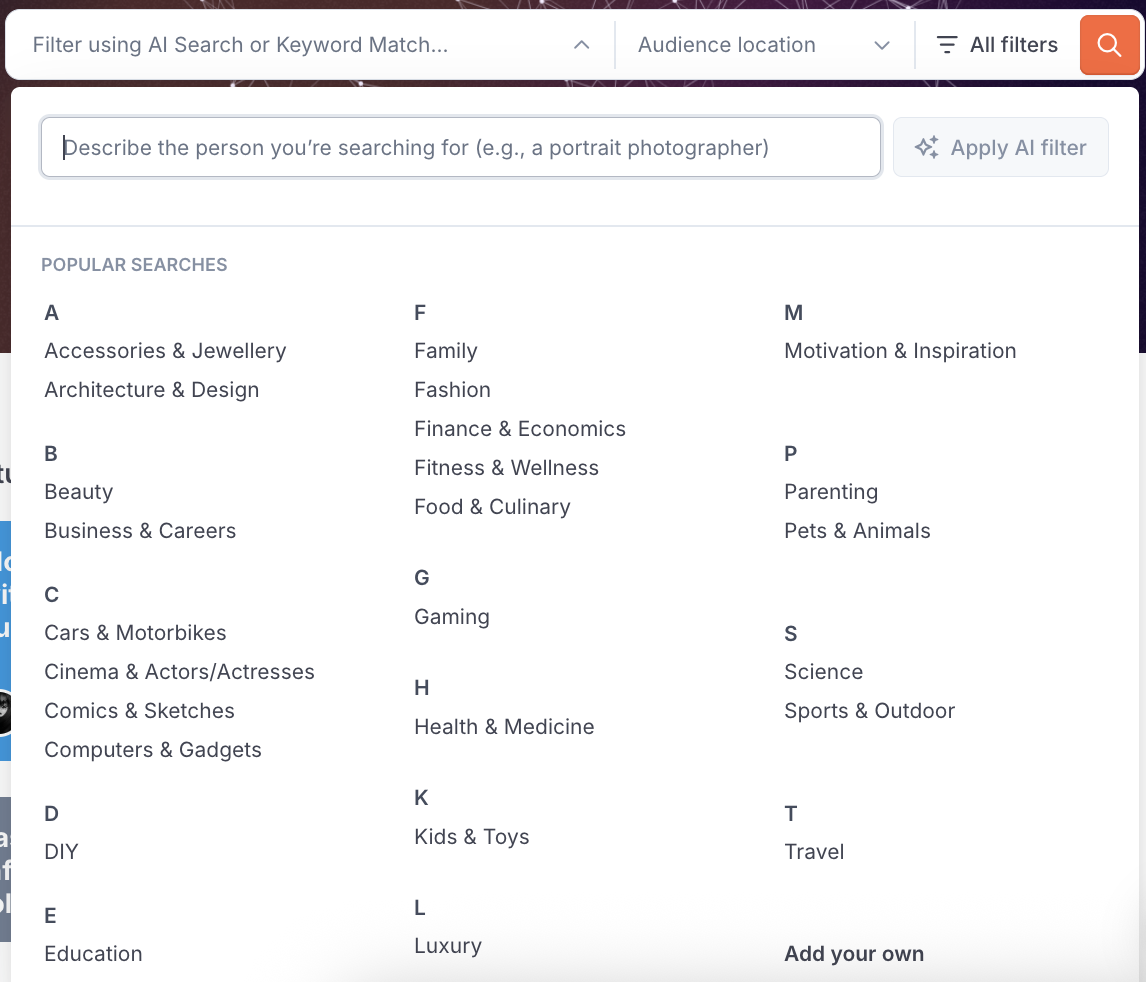 On the discovery side, it supports both keyword-based and AI-powered search, which is helpful when creators don’t describe themselves in obvious or consistent ways. You can also exclude certain terms to avoid irrelevant results, which keeps searches cleaner and more focused.
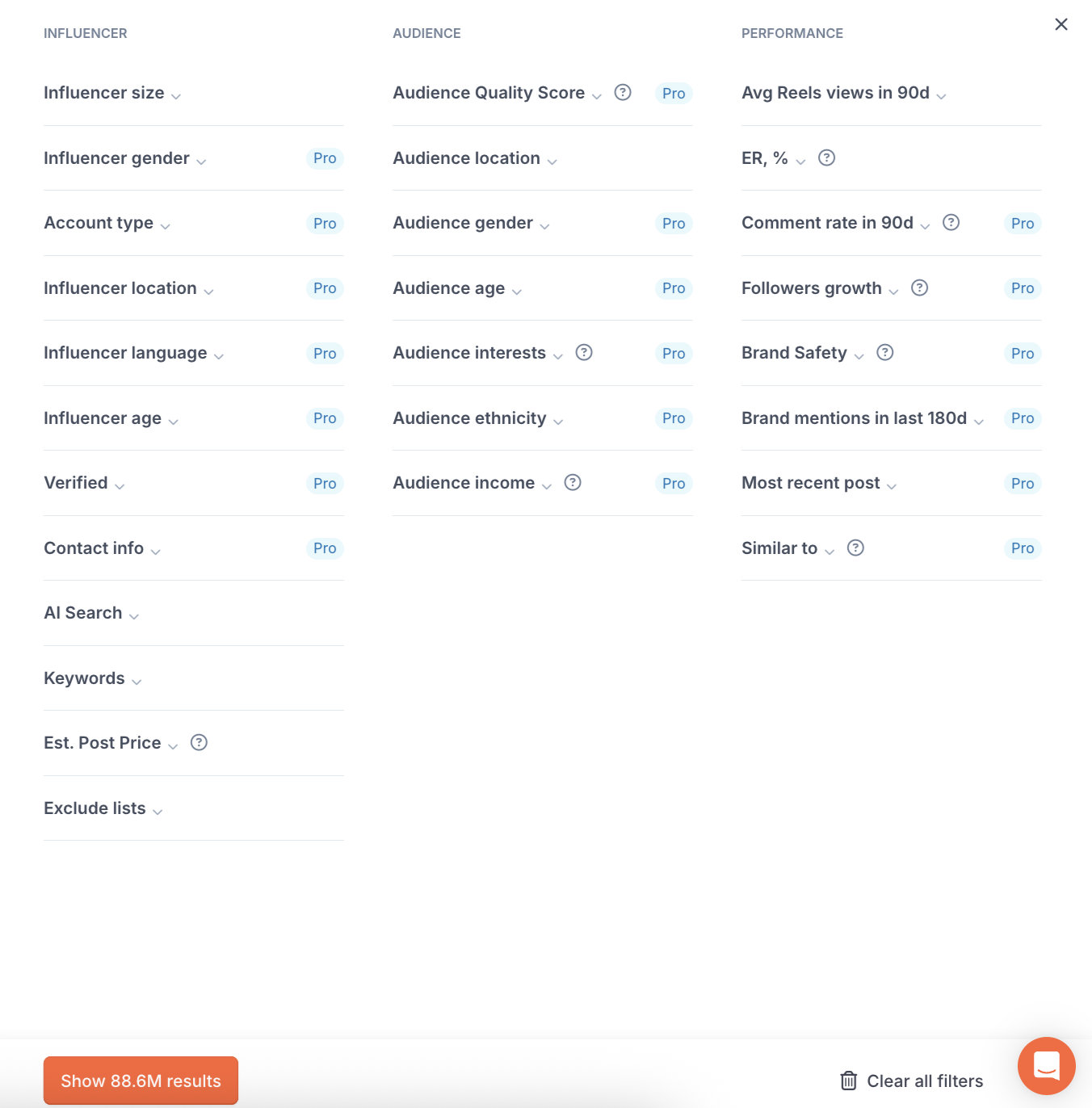 HypeAuditor’s main discovery capabilities include:
A creator database with 219M+ profiles across Instagram, YouTube, TikTok, X (Twitter), and Twitch
25+ filters covering audience size, audience location, language, niche, engagement rate, and additional campaign-relevant criteria
Brand safety and pricing-related filters, including estimated post cost, to help narrow shortlists early
AI-powered search that finds creators based on topics and content context, not only exact keyword matches, with the option to exclude irrelevant terms
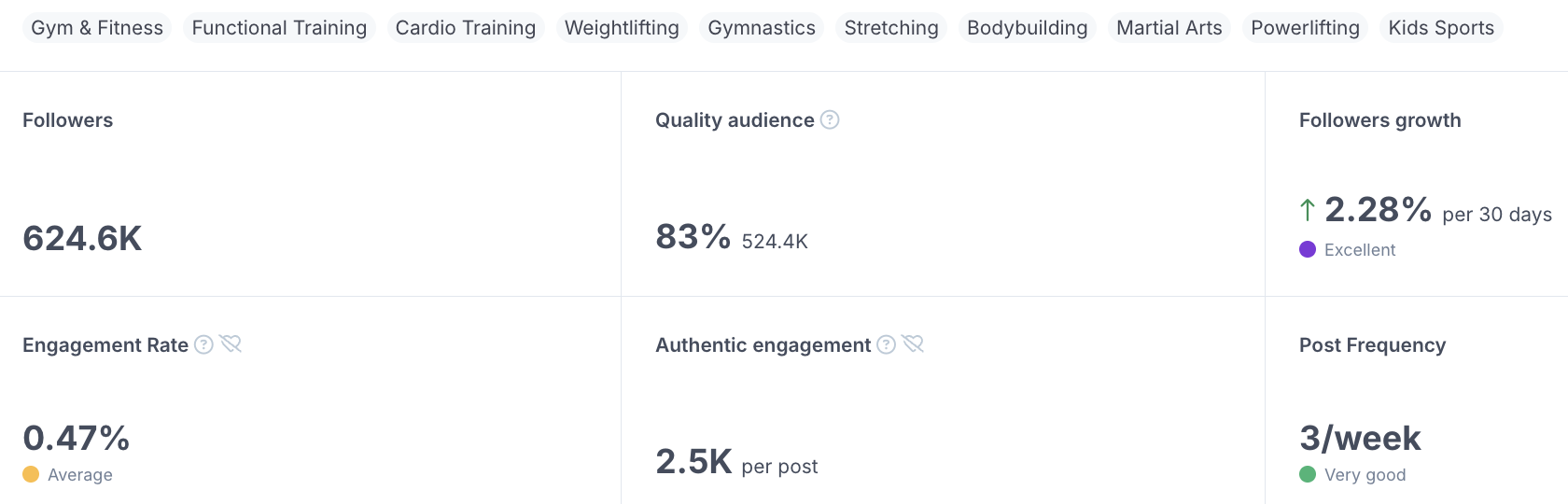 On the analysis side, HypeAuditor brings together the indicators teams usually have to check separately. Instead of checking metrics one by one, you can see how an influencer’s audience and engagement change over time through a single report. This includes:
Audience location and quality indicators
Engagement patterns across posts and formats
Follower and engagement trends over time
Data points that help highlight unusual or inconsistent behavior
HypeAuditor combines audience health into a single Audience Quality Score. The score reflects several factors, including how real and engaged the audience appears and whether growth and interaction patterns look natural. It helps you quickly understand how trustworthy a profile is and decide which creators are worth reviewing in more detail.
 The platform also flags suspicious activity, like abnormal follower behavior or engagement that doesn’t align with reach. These insights are useful when accuracy matters, whether you’re deciding who to partner with or explaining your choices internally.
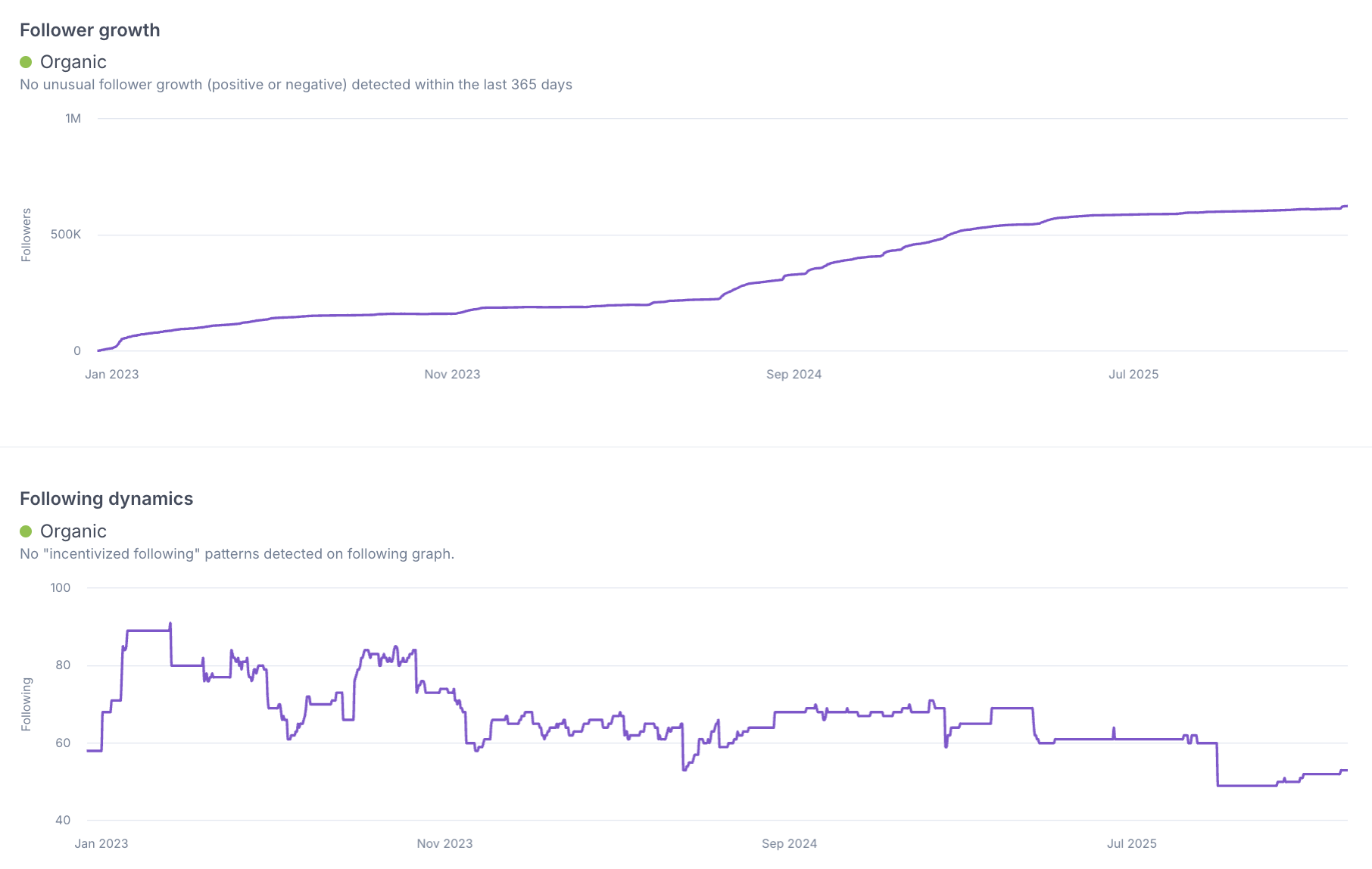 The platform also features a fraud detection system that identifies suspicious follower activity, bot accounts, and manipulated engagement. These insights are crucial for businesses that rely on accurate reporting and genuine reach. Brands can also compare influencer performance with similar creators in the same space, and use AI-powered reports to make planning and optimization decisions easier.
However, if you already use another platform for discovery or outreach, that’s fine. Pair it with strong verification and analytics capabilities like the ones outlined above. What matters is not the number of tools you use, but whether your setup helps you consistently identify genuine influencers and clearly explain why they’re the right choice.
Wrapping up
So those are the main types of tools you can use to find and analyze influencers. Some brands may need all of them, while others can operate just fine with one or a few, depending on their goals and team setup. If you’re looking for practicality and convenience, an all-in-one solution like HypeAuditor is a solid option to consider.
One last thing to keep in mind: finding and analyzing influencers comes down to being careful and precise. Let the data guide your decisions instead of relying on gut feelings or surface-level appeal. At the end of the day, what matters most is choosing creators who can deliver real and impactful results.